

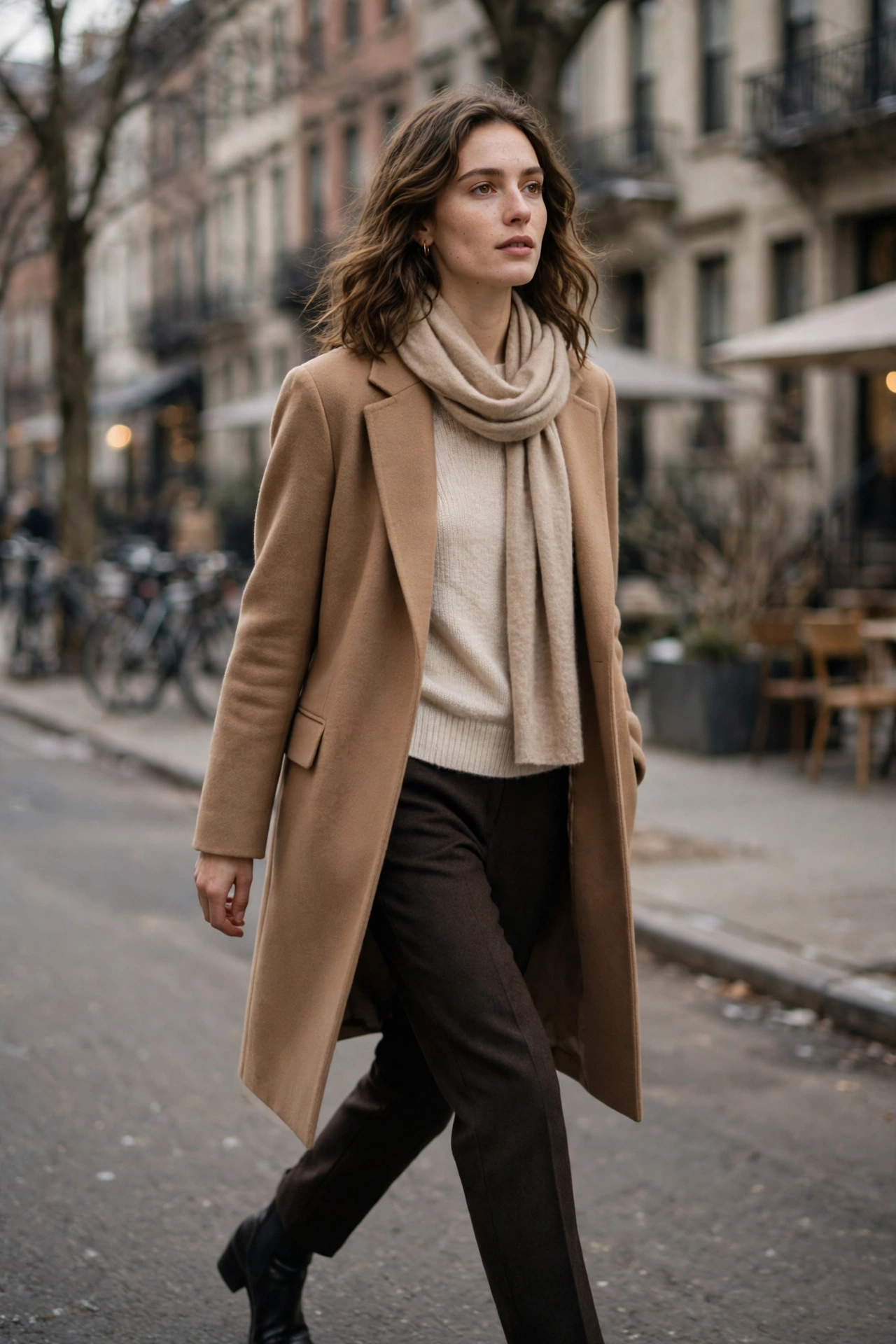
The trick to winter layering is not more clothes. It is thinner clothes, in the right order, with the right fit. Most people look bulky in winter because every layer is thick, every layer is loose, and nothing has a shape. Fix those three things and you can stay warm in freezing weather and still look like yourself.
This guide walks through the order that works, the fabrics that actually keep you warm without weight, and the small fitting mistakes that add visual bulk.
The simple rule: thin inside, structured outside
Think of winter outfits as three layers, each with one job.
- Base layer: sits on your skin and manages warmth. Thin, close-fitting, soft.
- Middle layer: adds insulation. A fine knit, a thin fleece, or a light quilted piece.
- Outer layer: blocks wind and cold. A coat with structure — this is the layer people see.
Problems start when two layers try to do the same job. Two chunky knits under a puffer will always look heavy. One thin knit under a well-cut coat looks clean.
Start with a base layer that actually fits
A base layer should feel like a second skin, not like a shirt. If it bunches at the waist or bags at the elbows, it will push every layer above it out of shape.
Good base layer fabrics are merino wool, silk blends, and modern thermal knits. Cotton is the one to avoid here. It holds moisture, and once it gets damp from walking or commuting, it feels cold against your skin.
You do not need a special “thermal” label. A thin, long-sleeved merino top does the job for most winter days. On very cold days, add thermal leggings under trousers rather than a second pair of thick trousers — same warmth, far less bulk.
The middle layer: one warm piece, not two
This is where most outfits go wrong. Pick one middle layer and let it do the work.
A fine-gauge knit sweater is the easiest choice. It traps warmth, sits flat under a coat, and looks smart on its own when you take the coat off indoors. A thin cashmere-blend or merino crew neck beats a chunky cable knit for layering every time — the chunky knit is lovely on its own, but it fights with a coat.
Other middle layers that work well:
- A thin quilted gilet under a coat, for extra core warmth without sleeve bulk.
- A fitted cardigan worn open, which gives you a vertical line down the middle of the outfit.
- A light fleece under a casual coat, if the day is more outdoors than office.
If you are still cold with one middle layer, the answer is usually a better base layer or a warmer coat — not a second sweater.
Your coat should have shape
A shapeless coat makes every layer underneath look bigger. When you try on a winter coat, check three things:
- Shoulders: the seam should sit on your actual shoulder, not droop past it.
- Waist: even a straight coat should have some definition. A belt, a slight taper, or a princess seam all help.
- Length: a coat that ends mid-thigh or at the knee is easier to layer under than a very long, boxy one.
Single-breasted coats tend to look slimmer than double-breasted ones. That does not mean double-breasted is off limits — it just needs a cleaner fit through the body.
And button or zip your coat up when you are outside. An open coat flapping over layers reads as bulk. Closed, it reads as one clean shape.
Colour and proportion do quiet work
Dark colours recede, light colours come forward. You do not need an all-black outfit, but keeping your bulkiest layer in a darker shade helps it sit back visually.
Proportion matters more than people think. If your coat is long and your knit is long, the outfit has no break point. Try a shorter knit with a longer coat, or tuck the front of a fine knit into high-waisted trousers. That one tuck creates a waistline and instantly slims the whole look.
Monochrome outfits — different shades of one colour family — also help. A camel coat over a cream knit and tan trousers looks long and lean, even though it is three warm layers.
Fabrics that warm without weight
Some fabrics give you a lot of warmth for very little thickness:
- Merino wool: warm, breathable, thin. The best base and mid-layer fabric.
- Cashmere blends: soft and warm at a light weight, though they need gentler washing.
- Down or synthetic fill: for outer layers, a thin quilted down coat can be warmer than a thick wool coat and much lighter.
- Technical fleece: light and warm, best kept as a hidden middle layer rather than the visible one.
Wool coats look beautiful, but a heavy wool coat plus a heavy knit is a lot of weight on your shoulders all day. If you walk or commute, a lighter coat with a good lining often feels better by the afternoon.
Common layering mistakes to avoid
- Two thick layers together. One thick piece is a statement. Two is a snowman.
- Sleeves that bunch. If your coat sleeve is tight over a chunky knit cuff, size the knit down or pick a coat with a wider sleeve.
- Skirts with bare legs. If you wear a skirt in winter, opaque tights or thermal tights plus knee boots keep you warm without adding a bulky layer on top.
- Scarves piled at the neck. One scarf, looped once or twice, is enough. A huge wrapped scarf adds bulk exactly where you do not want it — around your face.
- Forgetting the bottom half. Warm legs change everything. Thermal tights under trousers or a long skirt mean your top half needs one less layer.
Three outfits that prove the point
For the office: merino base layer, fine-knit crew neck in a dark shade, tailored single-breasted coat, slim trousers, ankle boots. Warm, and you look ready for a meeting the moment the coat comes off.
For a cold weekend walk: thermal top, thin fleece, quilted down coat, jeans, waterproof boots, one scarf, gloves. Nothing fancy, nothing bulky, and you will not be cold.
For an evening out: silk-blend camisole base, fitted velvet or fine-knit top, long structured coat, midi skirt with opaque tights, heeled boots. The coat does the warming, the outfit underneath does the talking.
How to test an outfit before you leave
Stand in front of a mirror and do three things: button the coat, sit down, and walk a few steps. If the layers pull, bunch, or ride up, adjust now, not outside in the cold. Sit down especially — an outfit that looks fine standing can feel tight and look lumpy once you sit.
Also, check the back view. Most of us only check the front. Layers that bunch at the back waistline are the ones other people actually see all day.
Frequently asked questions
How many layers do I need in very cold weather?
Three layers are enough for most winter days: a fitted base, one insulating middle layer, and a windproof outer layer. If you are still cold, upgrade the quality of one layer rather than adding a fourth.
What is the best base layer fabric for winter?
Merino wool is the most reliable choice — warm, breathable, and thin. Silk blends are a good lighter option. Avoid cotton as a base layer because it holds moisture and feels cold once damp.
Can I layer a dress in winter without looking bulky?
Yes. Wear thermal tights underneath, a fine knit over the dress if it is sleeveless, and a structured coat on top. Keep the coat knee-length or longer so the outfit reads as one long line.
Why does my outfit look bulky even with thin layers?
Usually the fit is the problem, not the thickness. Check that each layer sits flat — no bunching at the waist, elbows, or shoulders — and that your coat has some shape at the waist and shoulders.
Is it better to wear one heavy coat or layers?
Layers win for most people. They adjust through the day — you can take a layer off indoors — and a thin, well-fitted set of layers looks slimmer than one heavy coat over a sweater.
Related reading on Favorite Magazine: How to Style a Wool Scarf, Winter Coat Styles, Capsule Wardrobe Essentials.