
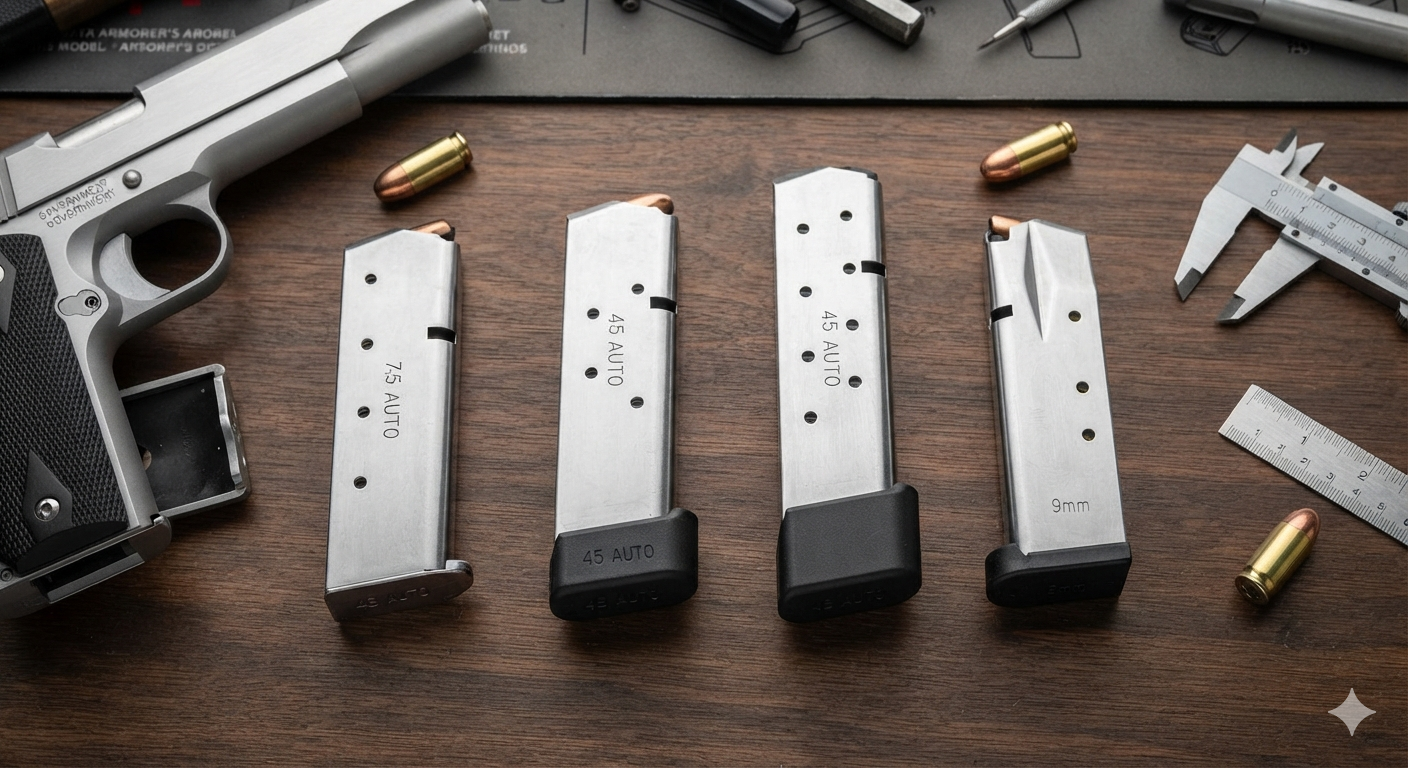
Finding the perfect balance between firepower and concealability starts with understanding your firearm’s dimensions inside and out. Shooters often struggle with frustrating feeding issues simply because they purchased the wrong aftermarket parts for their specific frame.
Selecting the correct 1911 magazine size is crucial for reliable feeding, proper grip seating, and overall defensive confidence. Whether you carry a classic full-size Government model or a modern compact variant, getting the exact right fit matters immensely.
This guide breaks down everything from standard single-stack capacities to modern extended base pads and follower upgrades. By the end, you will know exactly which dimensions work best for your specific shooting and daily carry needs.
Understanding Standard 1911 Magazine Size Configurations
The original John Moses Browning design established a very specific blueprint for ammunition feeding that lasted for decades. Most shooters readily recognize the classic seven-round flush-fit tube as the historical standard for the heavy .45 ACP cartridge.
However, modern engineering has successfully expanded those historical limitations without physically altering the external grip frame dimensions. Your ideal 1911 magazine size depends heavily on your specific frame cut, daily carry style, and caliber choice.
Historically, the US military required a strict standard 7-round capacity when officially adopting the pistol back in 1911. Modern flush-fit designs now successfully accommodate eight rounds by utilizing modified anti-tilt followers and much higher-tensile compression springs.
Government and Commander Frame Dimensions
Full-size Government and Commander frames share the exact same grip length and internal magazine well depth. This structural similarity means they utilize the exact same standard feeding tubes interchangeably without any awkward protrusion issues.
A traditional Government tube measures approximately 4.7 inches in length from the welded base plate to the top feed lips. This exact dimension comfortably accommodates seven or eight rounds of .45 ACP while sitting perfectly flush with the steel frame.
When shooting 9mm out of a Government frame, that identical exterior tube length typically holds nine or ten rounds. An internal spacer design accounts for the shorter 9mm cartridge overall length while actively maintaining the classic exterior dimensions.
Officer and Defender Compact Frames
Compact frames, frequently called Officer models, feature a distinctly shortened grip designed specifically for much deeper concealed carry. You cannot securely use a flush-fit Government tube in these smaller frames without significant and unsightly bottom protrusion.
The standard tube length for an Officer frame measures approximately 4.2 inches from top to bottom. This half-inch reduction typically limits the .45 ACP carrying capacity to only six or seven rounds, depending on the internal follower.
Inserting a longer tube into an Officer frame works mechanically, but it exposes the steel body and risks over-insertion. Many manufacturers successfully sell polymer grip sleeves to bridge this awkward gap and prevent structural damage to the ejector.
How Caliber Dictates Your 1911 Magazine Size
Caliber variations drastically alter the internal geometry of the feeding mechanism, even if the outside looks completely identical. A tube built for .45 ACP features vastly different feed lip spacing compared to a 9mm or .38 Super variant.
Choosing the correct 1911 magazine size requires perfectly matching both your vertical frame length and your chosen cartridge diameter. Utilizing the wrong caliber tube will immediately cause frustrating failure-to-feed malfunctions at the absolute worst possible moments.
Industry data shows that 9mm 1911 variants have surged massively in popularity, recently accounting for over 35% of all new sales. This demographic shift has flooded the aftermarket with highly reliable ten-round flush-fit options that were exceptionally rare a decade ago.
The Classic .45 ACP Baseline
The .45 ACP cartridge serves as the fundamental historical baseline for all single-stack feeding dimensions on this platform. Because the cartridge is exceptionally wide at 0.473 inches, overall capacity is naturally restricted by the vertical grip length.
Standard Government tubes hold seven or eight rounds, while specialized extended versions can hold up to ten. Ten-round .45 ACP tubes extend significantly below the grip frame, making them completely impractical for daily concealed carry.
9mm and .38 Super Options
Smaller diameter cartridges allow engineers to pack significantly more rounds into the exact same vertical frame space. The 9mm Luger and .38 Super remain highly popular for competitive shooting divisions specifically due to this obvious capacity advantage.
A flush-fit Government tube chambered in 9mm typically holds nine or ten rounds depending on the specific manufacturer. Extended variants built for competition can easily hold eleven or twelve rounds while still fitting effortlessly into standard belt pouches.
Single-Stack vs. Double-Stack Differences
The traditional single-stack design features heavy cartridges stacked directly on top of each other in a straight vertical column. This simple geometry creates a remarkably thin grip profile, which is why your chosen 1911 magazine size remains highly favored for comfortable inside-the-waistband carry.
Double-stack frames, commonly referred to as 2011s in the competitive world, stagger the cartridges in a wider zigzag pattern. This dramatically increases total capacity but requires a completely different frame width and a much bulkier internal magazine well.
A standard single-stack grip measures roughly 1.3 inches thick straight across the traditional wooden grip panels. In stark contrast, a double-stack grip often exceeds 1.5 inches, requiring a much wider steel tube to accommodate the staggered rounds.
Benefits of the Single-Stack
-
Concealability: The inherently slim profile actively prevents the pistol from printing under light t-shirts or summer clothing.
-
Ergonomics: Shooters with smaller hands can easily wrap their fingers around the grip for vastly superior recoil control.
-
Simplicity: Single-column feeding is mechanically reliable and much less prone to frustrating cartridge nose-diving issues.
-
Weight: A fully loaded single-stack is noticeably lighter and more comfortable to carry all day than a double-stack alternative.
Benefits of the Double-Stack
-
Capacity: Flush-fit tubes can hold an impressive 15 to 20 rounds of 9mm easily without requiring a reload.
-
Competition Ready: Less frequent reloading directly translates to much faster overall stage times in USPSA or IDPA matches.
-
Weight Distribution: A heavier base significantly reduces upward muzzle flip during aggressive rapid-fire strings.
-
Modern Enhancements: Most double-stacks feature heavily flared magwells that allow for lightning-fast, blind speed reloads.
Top Upgrades for Your 1911 Magazine Size Needs
Factory-supplied tubes are very often built to meet a strict price point rather than a high-performance standard. Serious shooters almost always upgrade their feeding mechanisms immediately to ensure flawless reliability under actual stress.
When consciously altering your 1911 magazine size with aftermarket base pads, internal spring tension becomes a critical operational factor. Adding capacity means the spring must travel further, fundamentally requiring a much stiffer, high-quality wire gauge.
Extensive industry testing indicates that nearly 90% of all semi-automatic malfunctions are directly tied to cheap or worn-out feeding mechanisms. Investing heavily in premium brands like Wilson Combat, Tripp Research, or Chip McCormick is highly recommended by every professional armorer.
Base Pads and Tactical Bumpers
Base pads attach directly to the bottom of the tube to protect the thin metal when dropped during aggressive speed reloads. They also successfully provide extra gripping surface if the tube gets stubbornly stuck in the frame due to environmental grit.
Standard flat metal base plates are genuinely excellent for deep concealment but offer absolutely zero structural drop protection. Polymer or heavy brass bumpers add necessary length and sometimes increase the overall capacity by one or two additional rounds.
Advanced Follower Designs
The follower is the internal piece of polymer or machined metal that physically pushes the heavy cartridges upward. Its specific geometric angle and material heavily dictate exactly how smoothly the top cartridge enters the steel firing chamber.
Anti-tilt polymer followers serve as the modern gold standard for highly reliable feeding across absolutely all available calibers. Skirted followers actively prevent the internal spring from binding, even when subjected to exceptionally heavy carbon fouling over time.
Maintenance Tips for Extended Capacities
Proper routine maintenance ensures that your defensive firearm functions reliably precisely when you need it the most. Regardless of your specific 1911 magazine size, extended capacity tubes are particularly sensitive to internal dirt and debris simply because of the much longer internal spring track.
You should thoroughly disassemble and scrub your feeding mechanisms every 500 rounds or immediately after any drop in the dirt. Never use heavy liquid gun oil inside the tube, as it will quickly attract highly abrasive sand and sticky carbon.
Steel springs naturally lose their upward tension through repeated compression cycles over an extended period of time. Proactively replacing internal springs every 3,000 to 5,000 rounds remains a remarkably cheap insurance policy against catastrophic feeding failures.
Frequently Asked Questions About 1911 Magazine Size
Can I securely use a full Government tube inside a smaller Officer frame? Yes, a longer Government tube will physically lock into a compact Officer frame and successfully feed ammunition reliably. However, it will awkwardly protrude from the bottom of the shortened grip, which can occasionally cause over-insertion damage if slammed home aggressively. Many experienced shooters simply use polymer spacers to safely prevent this mechanical issue.
What is the maximum reliable 1911 magazine size for the .45 ACP cartridge? For a standard single-stack frame, the absolute largest reliable extended tubes currently hold exactly 10 rounds of .45 ACP ammunition. These specific models extend roughly two full inches below the bottom of the grip. Larger drum options exist on the market, but professionals generally consider them unreliable novelties rather than serious defensive tools.
Why do some flush-fit tubes hold 7 rounds while others hold 8? The difference lies entirely within the internal follower geometry and the specific spring compression engineering. Modern engineered followers actively take up far less vertical space inside the steel tube. This advanced design allows an eighth round to fit perfectly within the exact same exterior 1911 magazine size dimensions as a vintage 7-round model.
Do 9mm and .45 ACP tubes use the exact same exterior dimensions? Yes, the exterior physical dimensions of a single-stack tube remain completely identical regardless of the internal caliber. This smart standardization ensures they fit perfectly into standard factory frame magwells. Internal steel spacers and highly specialized feed lips are then used internally to safely accommodate the much smaller 9mm cartridge.
How often should I proactively replace my internal magazine springs? For dedicated everyday carry or heavy competitive shooting, you should replace your internal springs roughly every 3,000 to 5,000 rounds. If you simply leave them fully loaded for long-term defensive purposes, replacing them annually safely ensures maximum upward pressure. This routine maintenance actively prevents unexpected and dangerous failure-to-feed malfunctions during an emergency.
Conclusion
Understanding the intricate mechanical details of your firearm’s feeding system translates directly to vastly better performance on the firing range. Your specific frame type, chosen caliber, and preferred daily carry method all directly dictate your ideal tactical equipment setup.
Finding the perfect 1911 magazine size is entirely about balancing necessary firepower with practical daily concealment. Whether you confidently stick to the classic seven-round flush fit or upgrade to a modern ten-round extended tube, internal quality matters above all else.
Always invest heavily in reputable, premium aftermarket brands to ensure your defensive firearm runs flawlessly under intense pressure. If you are finally ready to reliably upgrade your daily loadout, review your frame dimensions, test new capacities on the range, and carry with confidence!